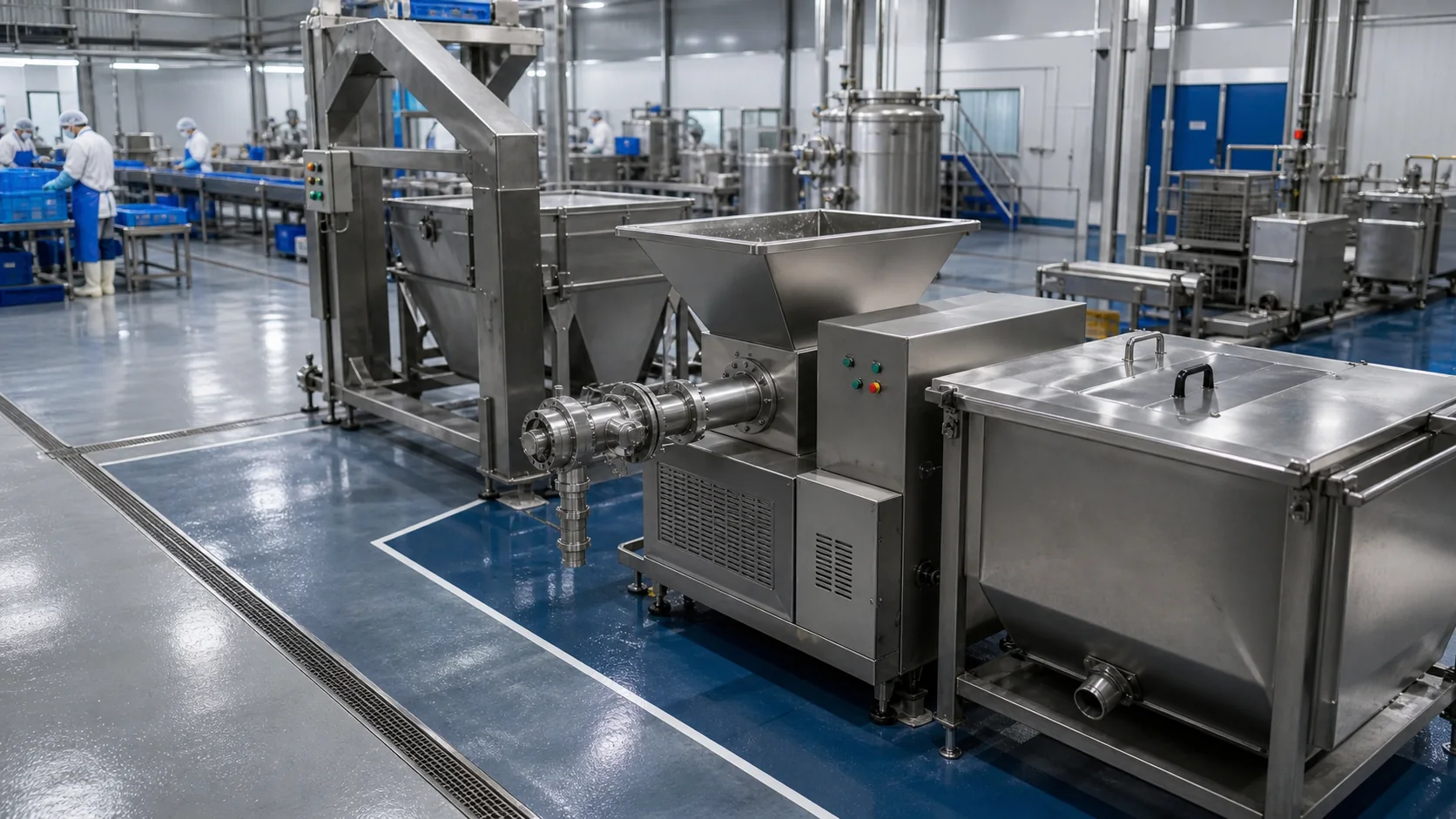
A sausage production line is not a single machine with a few accessories attached to it. For an industrial meat processor, it is a controlled workflow that turns chilled or prepared meat into filled, clipped, cooked, smoked, cooled, and packed sausage products. The line may be simple for a small fresh-sausage plant, or it may include grinding, chopping, vacuum mixing, vacuum filling, clipping, smoking, drying, cooking, cooling, and vacuum packaging for a larger factory.
This page is written for sausage factories, central kitchens, meat processors, and prepared-food plants in Southeast Asia, Central Asia, and the Middle East. These buyers usually care less about a decorative brochure and more about one practical question: which machines should be placed in the line so the product texture, casing style, output, and labor plan make sense?
What a Sausage Production Line Should Solve
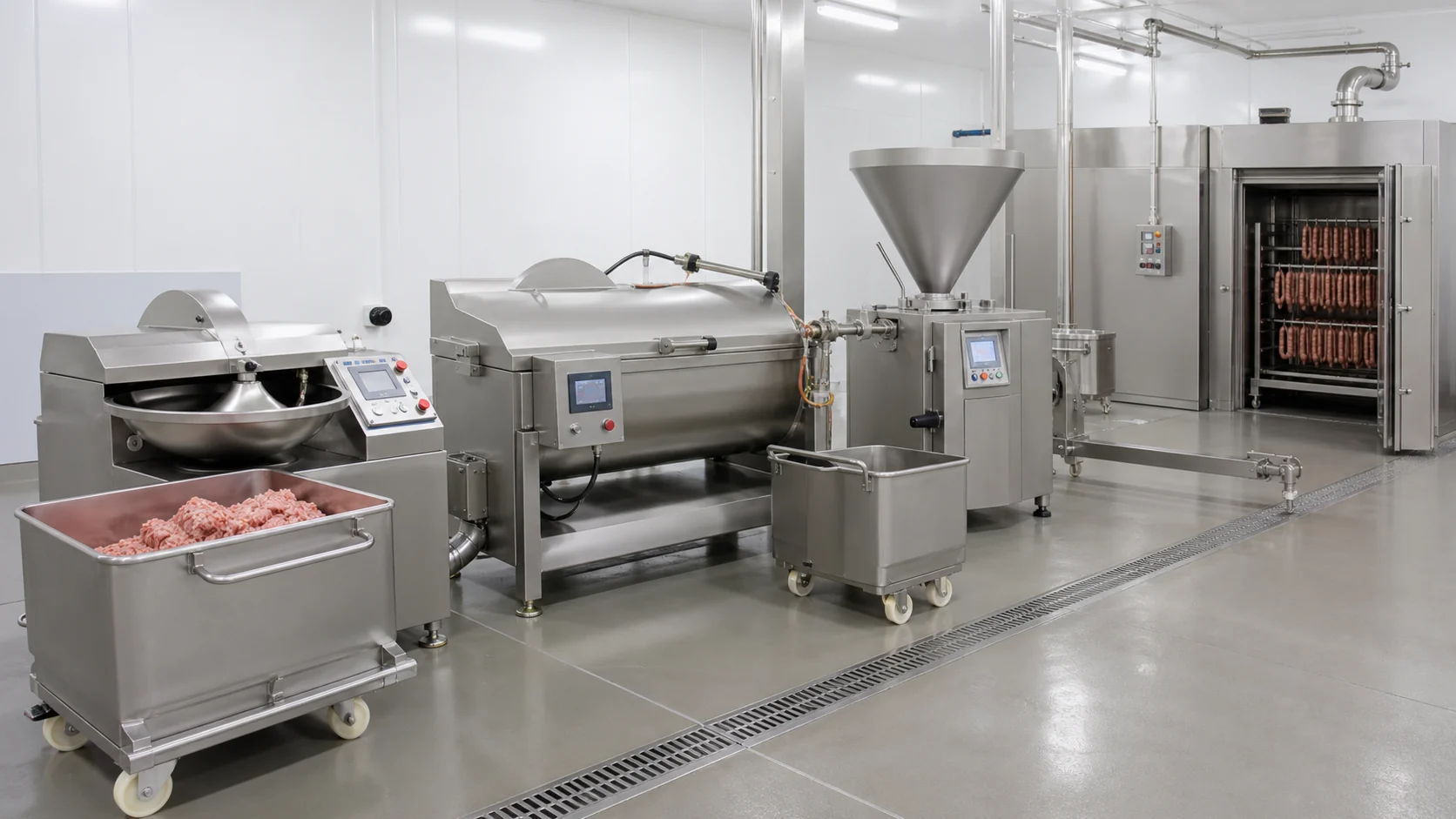
A good sausage production line should solve five factory problems at the same time: raw meat preparation, recipe mixing, air control, portion control, and downstream heat treatment or packaging. If one step is weak, the final product can show broken emulsion, unstable weight, air pockets, casing burst, poor color, or inconsistent shelf life.
That is why a buyer should not ask only for a sausage filler quotation. A filler can place meat batter into casings, but it cannot correct poor grinding, poor chopping, insufficient mixing, unsuitable casing, or an incorrect smokehouse process. The right inquiry should describe the product first, then the factory can select the machines around that product.
Recommended Main Keyword and Search Intent
The main search intent for this product page is commercial selection. Buyers using terms such as sausage production line, sausage processing line, and sausage making machine line are usually not looking for a recipe. They are comparing equipment sequence, supplier capability, automation level, and whether the supplier can help them build a workable line.
Saved project data does not yet contain verified Semrush volume for this exact keyword. The keyword choice is therefore based on current Google SERP wording, B2B product terminology, and the equipment documents supplied for this project. It should be rechecked in Semrush for each target country before the page becomes the final pillar page for paid SEO planning.
Typical Sausage Processing Workflow
The standard workflow can be understood as a chain of decisions rather than a fixed machine list. A fresh sausage plant may not need the same smokehouse as a smoked sausage factory. A small central kitchen may not need the same automatic clipping configuration as a large halal meat processor. The line below is a practical reference sequence:
| Process stage | Typical equipment | Main purpose |
|---|---|---|
| Raw meat preparation | Meat grinder, frozen meat flaker, trimming table | Prepare meat size and temperature for later mixing |
| Fine chopping or emulsifying | Bowl cutter or vacuum bowl cutter | Develop a stable meat batter for emulsified sausages |
| Recipe mixing | Vacuum meat mixer or stuffing mixer | Blend meat, fat, seasoning, water, and additives evenly |
| Filling and portioning | Vacuum sausage stuffer | Fill casings with controlled portions and reduced air |
| Closing or linking | Clipping machine, linking device, tying machine | Seal or shape each portion according to product type |
| Thermal processing | Smokehouse, cooking oven, drying room | Cook, dry, smoke, or color the sausage as required |
| Final handling | Cooling rack, stainless steel cart, vacuum packaging machine | Move, cool, inspect, and pack finished products |
Meat Preparation Before Filling
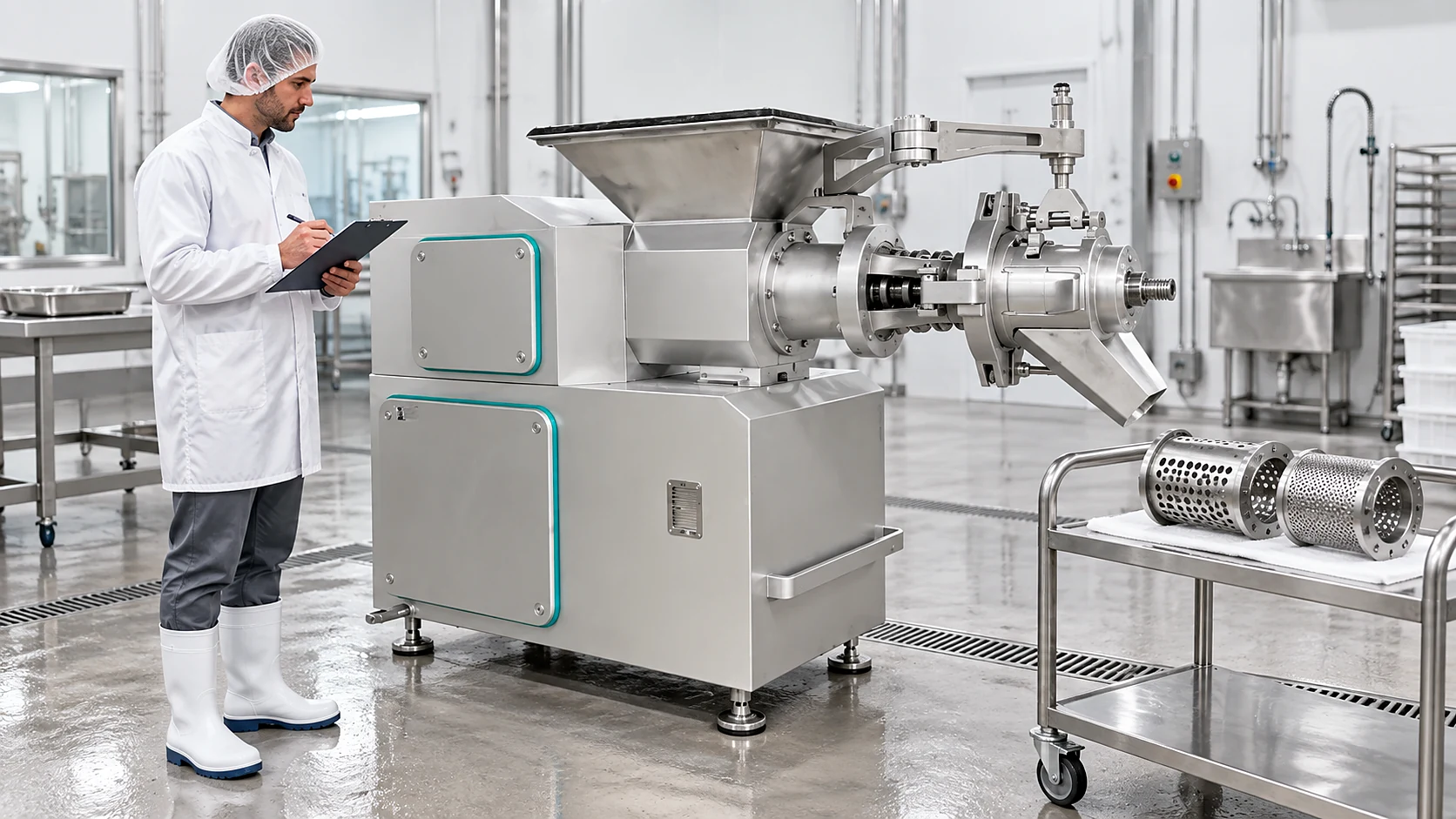
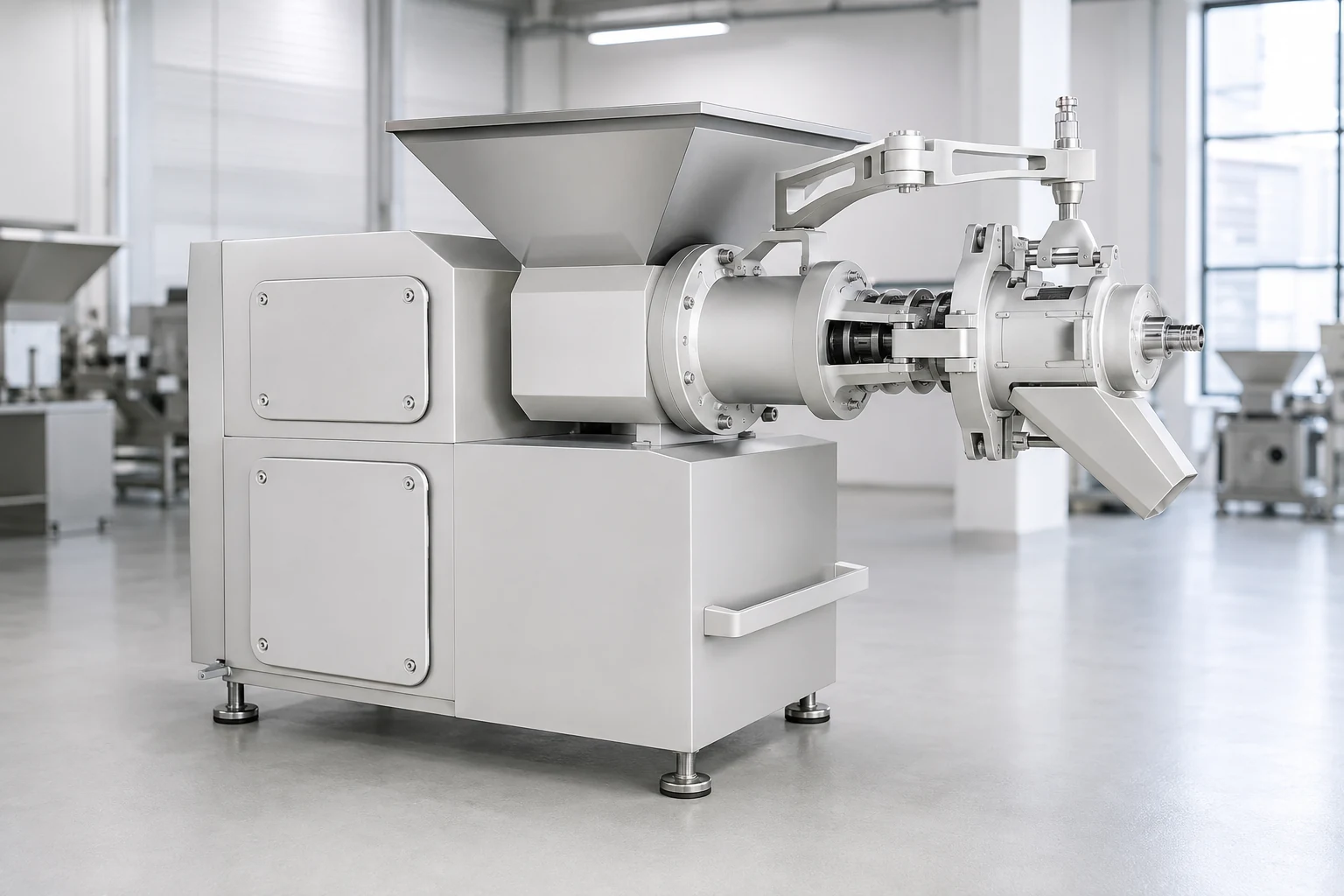
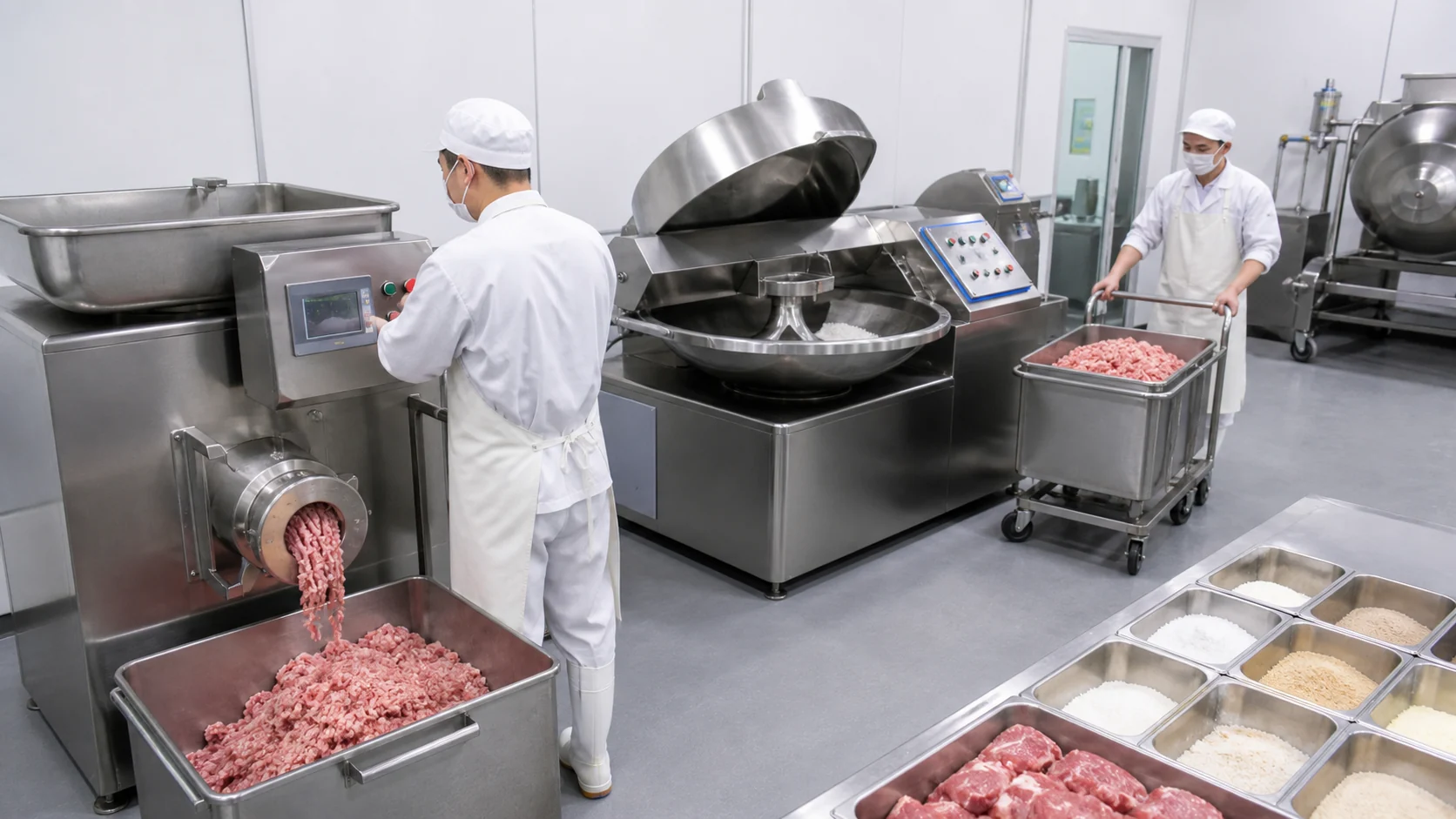
The first visible machine in many sausage factories is a meat grinder or mincer. Its job is size reduction, not recipe correction. For fresh sausage, a controlled particle size helps the filler produce a more even appearance. For emulsified sausage, grinding may be followed by bowl cutting to create a finer batter. The supplied JR-130 grinder data lists a 130 mm plate diameter, selectable hole sizes, 380 V power supply, and a stated capacity range of 600 to 1000 kg/h. These figures should be confirmed against the final quotation and material test, because real output depends on meat condition, plate size, temperature, and operator practice.
A bowl cutter has a different role. It uses high-speed knives and a rotating bowl to chop and mix meat, fat, seasoning, and other ingredients. For emulsified products such as hot dogs or fine-texture sausages, this stage can strongly influence product bite, water retention, and uniformity. A buyer should describe the target product texture before choosing between a simple grinder-based line and a line with a bowl cutter.
Why Vacuum Mixing Matters in Sausage Production
After size reduction or chopping, the meat batter must be mixed consistently. A vacuum meat mixer or vacuum stuffing mixer helps blend the formulation while reducing trapped air. Less visible air can support a tighter product structure and a cleaner filling result, especially when the product will later be stuffed into casings or packed for chilled sale.
The supplied BX-200 vacuum mixer data lists a 1670 x 700 x 1400 mm machine size, 380 V 50 Hz power, 5.35 kW power rating, water-ring or oil-cooled vacuum pump options, 40 r/min mixing speed, -0.08 MPa vacuum degree, and about 150 kg per batch. These are useful starting points for a mid-sized batch line, but the final selection should still consider batch rhythm, meat temperature, product viscosity, cleaning time, and how the mixer discharges into the next machine.
Vacuum Sausage Filler and Clipping Configuration
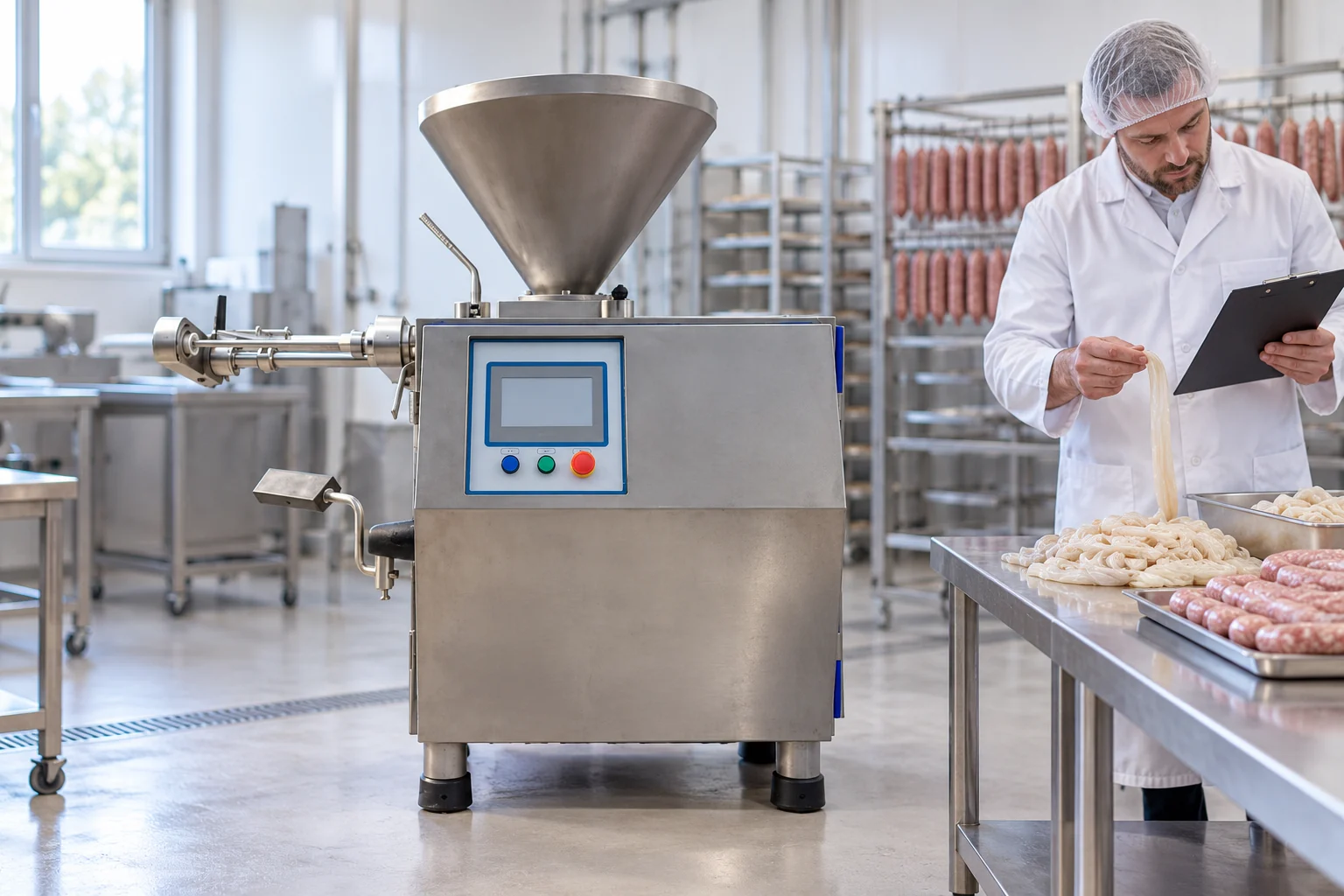
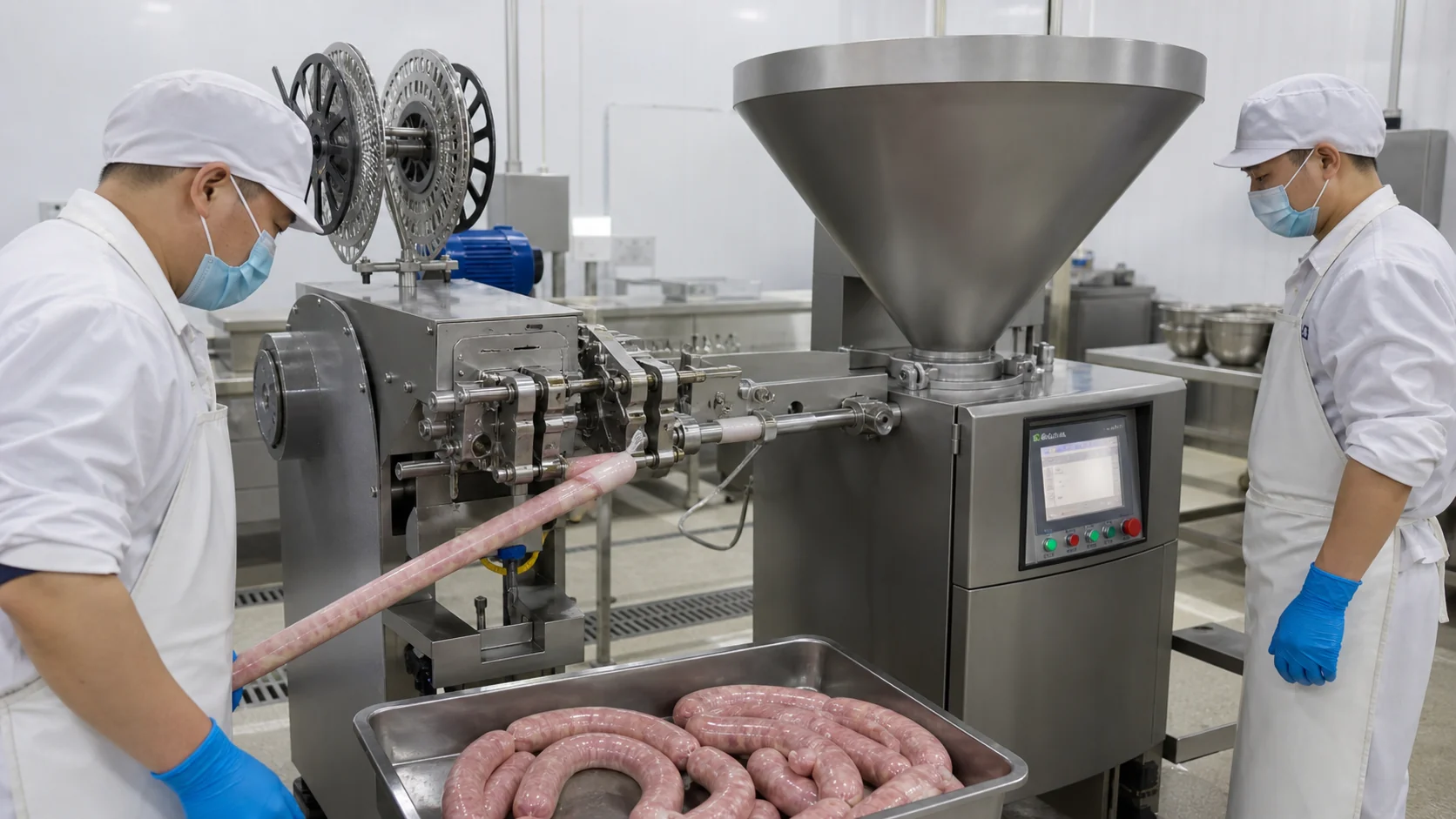
The vacuum sausage stuffer is the point where the prepared meat batter becomes a portioned sausage product. For industrial buyers, the important question is not only filling speed. Portion range, meat particle size, casing type, hopper capacity, control system, cleaning access, and whether the filler connects smoothly to a clipper or linking system are all part of the decision.
The supplied ZKG-3500 and ZKG-6500 vacuum quantitative filler data gives two useful configuration levels. The documents list a dosing range of 6 to 99999 g, 240 L hopper capacity, 380 V rated voltage, and straight filling capacity references of 3500 kg/h and 6000 kg/h. The smaller configuration is described for material below 30 mm, while the larger configuration is described for material below 50 to 80 mm after tumbling. These values are helpful for quotation discussion, but they should not be treated as guaranteed output for every sausage recipe.
A mechanical double clipping machine can be used when the product requires clipped ends rather than simple twisting or linking. The supplied JCK-130 data lists a clipping speed range of 10 to 90 times per minute, casing flat width range of 32 to 130 mm, 2.7 kW power, 220 V rated voltage, and compatibility with cellulose and nylon casings. This makes the clipping stage a serious selection item, not a small accessory.
Smokehouse, Cooking, Drying, and Color Control
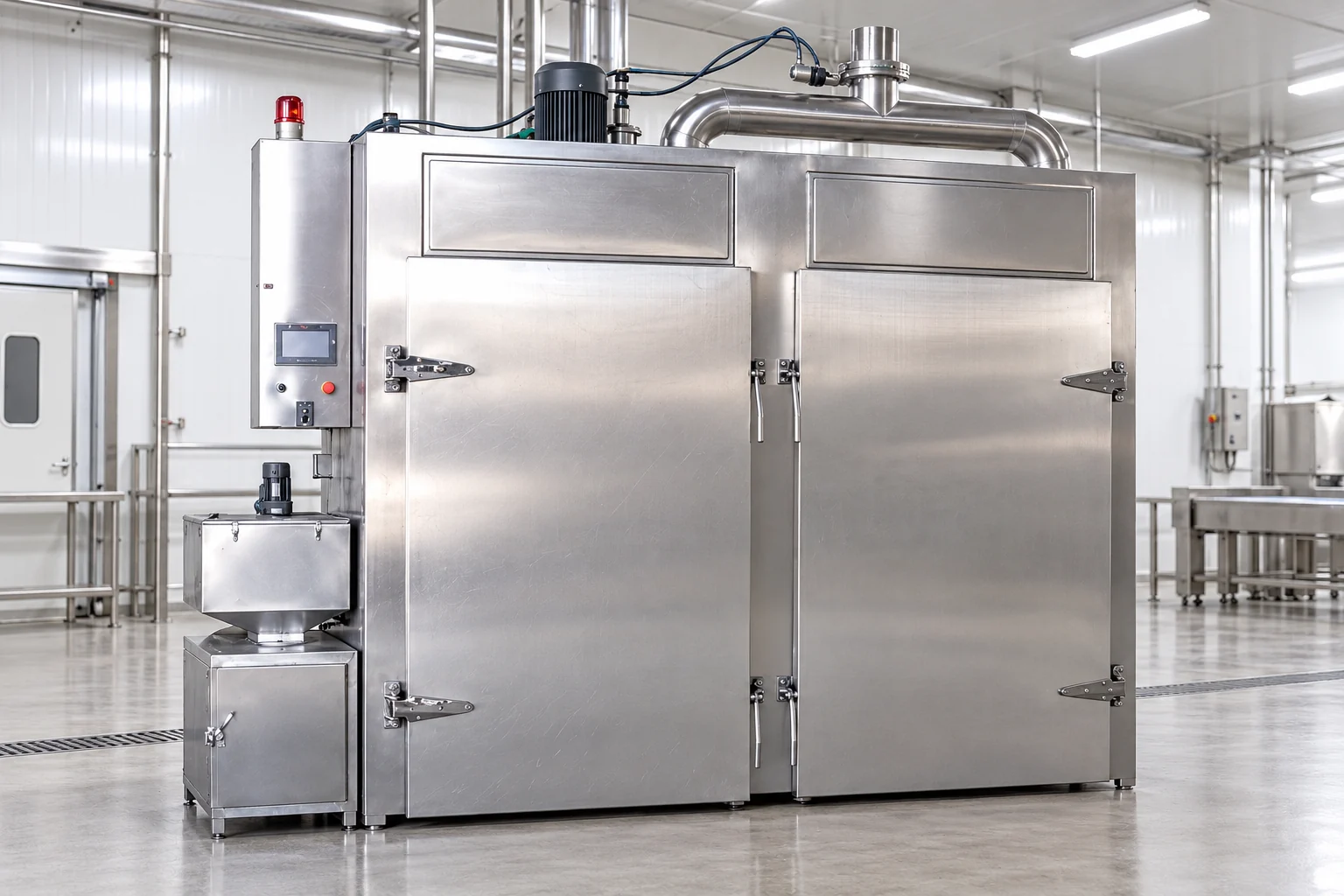
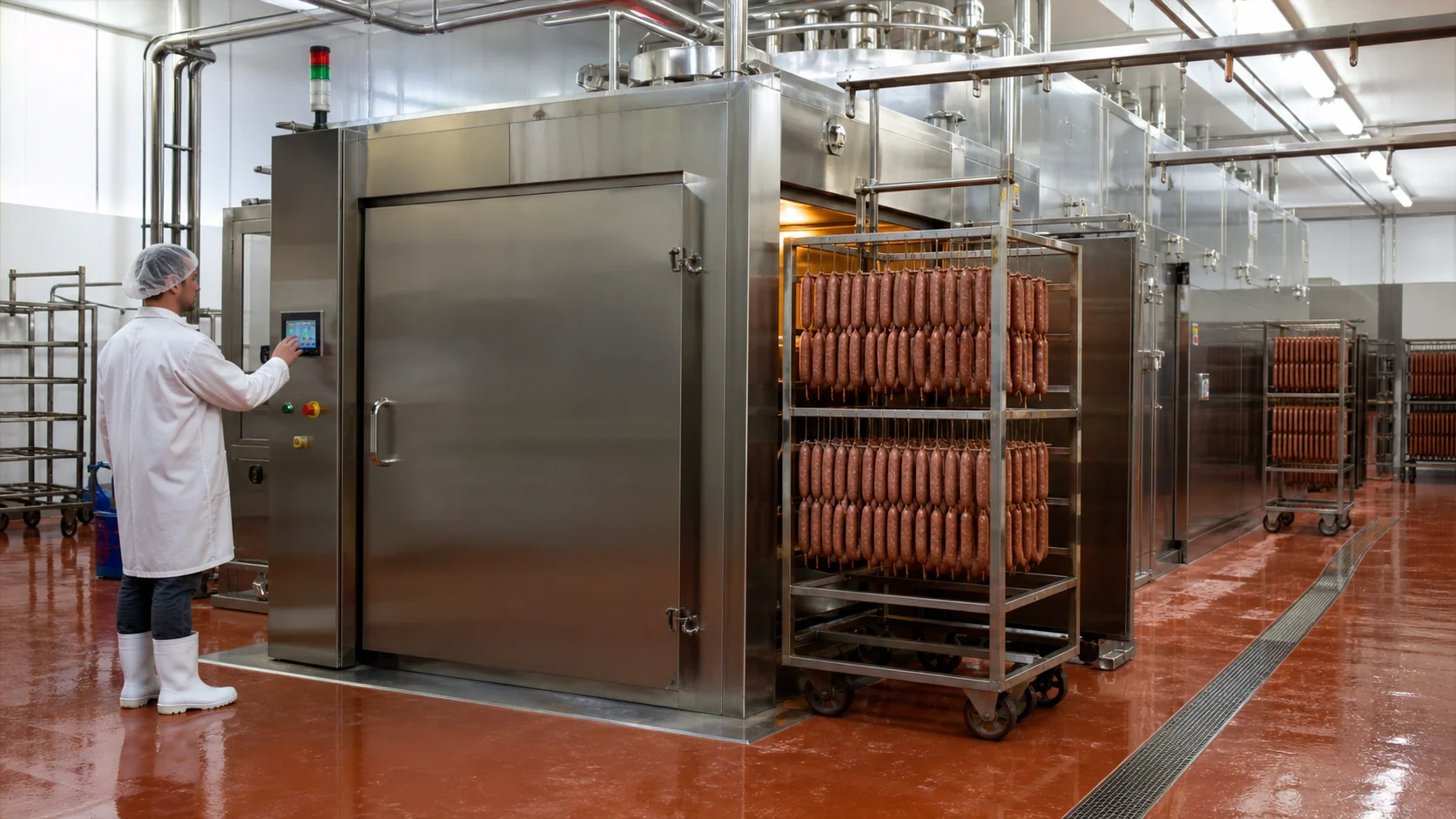
Many sausage products require a smokehouse or thermal processing room after filling. The exact process depends on the product: fresh sausage may go directly to chilling or packaging, while smoked sausage, cooked sausage, and dried sausage require controlled heat, humidity, air circulation, and sometimes smoke generation. The same word “sausage” can therefore mean very different equipment needs.
The supplied YX-1000 tunnel smokehouse information lists 1000 kg per chamber, steam heating power, steam demand, heating pressure, electric heating option, normal temperature to 110°C under steam heating, normal temperature to 140°C under electric heating, trolley information, and SUS304 stainless steel material. These facts support a larger thermal-processing configuration, but the buyer still needs to provide product diameter, casing type, target color, cooking method, local utilities, and expected daily batches.
Packaging and Final Handling
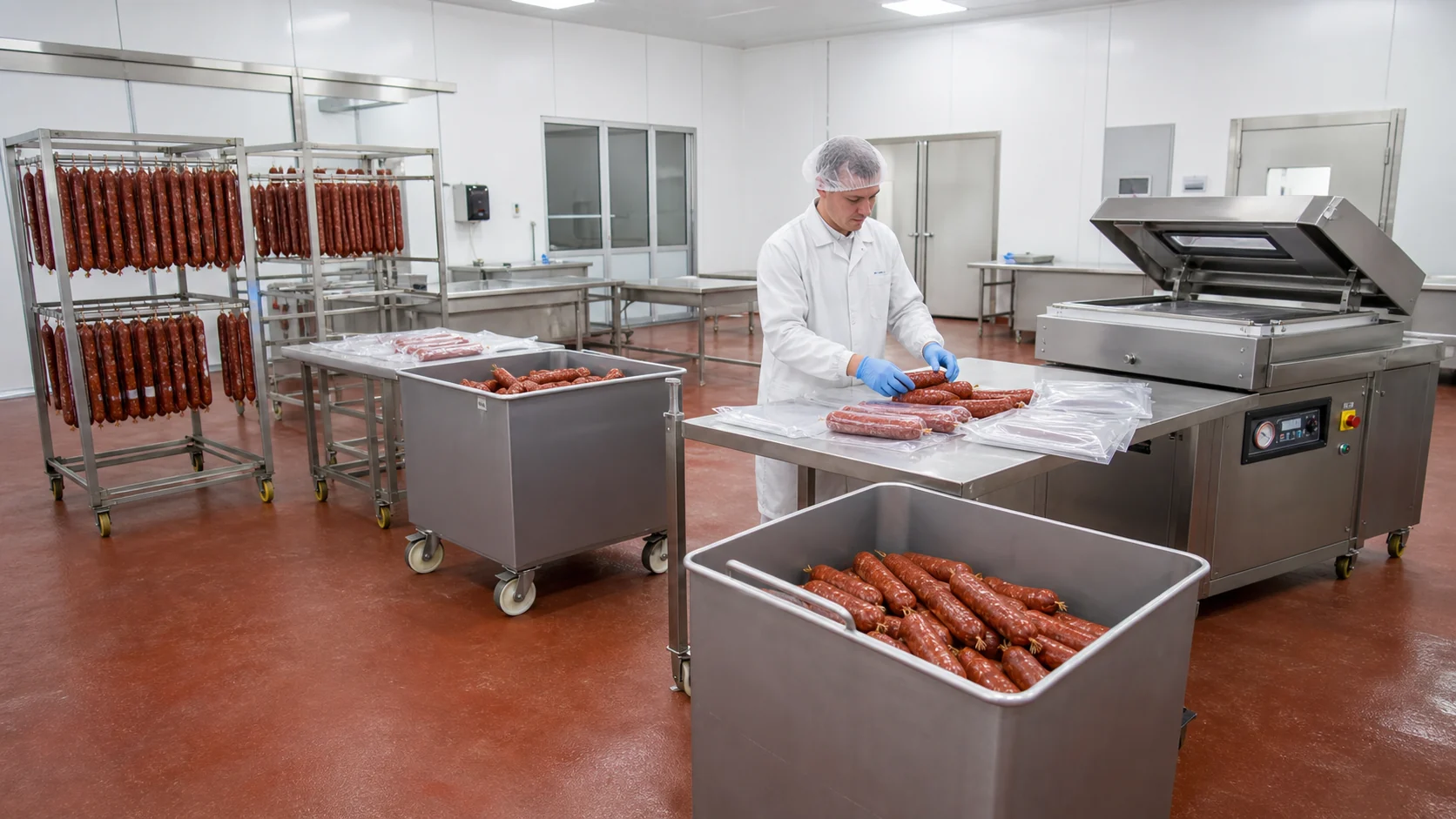
Finished sausage handling is often underestimated. After cooking or smoking, products usually need cooling, staging, inspection, and packaging. Stainless steel carts, racks, vacuum packaging machines, and clean transfer routes affect labor efficiency and hygiene management. A line that looks efficient on the filling side can still become slow if finished products wait too long before packing.
The supplied general equipment list includes a 600-type vacuum packaging machine with chamber size information, two sealing strips, 2.25 kW power, and a raised-lid customization note. It also includes stainless steel carts with 304 stainless steel material, 3 mm sheet thickness, and an approximate loading range of 30 to 45 kg. These details are useful when designing the movement of product between cooking, cooling, and packing.
How to Choose the Right Sausage Line Configuration
A buyer should start with the finished product, not the equipment list. Fresh pork sausage, chicken sausage, smoked sausage, hot dog, fermented sausage, and large-diameter meat chub all place different demands on grinding, emulsifying, filling, casing, clipping, cooking, and packaging. The best configuration is the one that fits the product, labor plan, utilities, and available factory space.
For a small batch operation, a practical line may include a grinder, mixer, pneumatic or vacuum filler, clipping or tying machine, and a simple packaging process. For a higher-output factory, the line may add a frozen meat flaker, bowl cutter, vacuum mixer, high-capacity vacuum filler, double clipping machine, smokehouse, cooling carts, and vacuum packaging equipment. Neither approach is automatically better. The correct choice depends on daily target output, recipe type, casing style, and budget.
Important Questions Before Requesting a Quotation
A useful quotation for a sausage production line needs more than a machine name. Before asking for price, prepare the product type, raw meat condition, target portion weight, casing material, sausage diameter, hourly output, number of shifts, voltage, steam availability, factory floor plan, and packaging style. If the product must comply with halal, export, supermarket, or cold-chain requirements, tell the supplier early so the hygiene and process plan can be reviewed properly.
For Central Asia, Southeast Asia, and Middle Eastern markets, utilities and climate are especially important. Steam availability, water quality, ambient temperature, and operator training can all affect how the line performs. A serious supplier should ask these questions before recommending a final configuration.
Why Work With DF Food Machinery
DF Food Machinery can help buyers plan a sausage processing line around the real production target instead of selling one isolated machine. The product page can connect related machines such as the industrial frozen meat grinder machine, commercial bowl cutter, industrial vacuum meat mixer, industrial vacuum sausage stuffer, meat chub clipping machine, commercial smoking oven, and industrial double chamber vacuum packaging machine.
If you are planning a new sausage factory or upgrading an existing meat-processing room, send the product type, target output, casing style, voltage, and available workshop size through the contact page. The next step should be a configuration discussion, not a blind price list.
Product Page Summary
A sausage production line should be designed as a connected process: prepare the meat, control particle size, mix under suitable conditions, fill and portion accurately, close the casing properly, process the sausage with the right thermal method, and pack it without creating a new bottleneck. The right line may be compact or highly automated. What matters is whether the equipment sequence matches the product and the factory’s operating reality.
Frequently Asked Questions
What machines are usually included in a sausage production line?
A typical industrial sausage production line may include a meat grinder, bowl cutter, vacuum mixer, vacuum sausage stuffer, clipping or linking machine, smokehouse, cooling carts, and vacuum packaging equipment. The final configuration depends on the sausage type, casing, output, and factory layout.
Do all sausage factories need a smokehouse?
No. Fresh sausage lines may go directly to chilling or packaging, while smoked, cooked, or dried sausage products usually need controlled thermal processing. The product type should decide whether a smokehouse is required.
Why is a vacuum sausage stuffer used in industrial production?
A vacuum sausage stuffer helps fill casings with more controlled portions while reducing trapped air in the meat batter. This supports cleaner appearance, more stable product structure, and better integration with clipping or linking equipment.
Should I choose a grinder or a bowl cutter for sausage meat preparation?
A grinder reduces meat to a selected particle size, while a bowl cutter chops and mixes meat, fat, and seasonings into a finer batter. Fresh sausage may rely mainly on grinding, while emulsified sausage often needs bowl cutting or vacuum bowl cutting.
What information is needed for a sausage line quotation?
A supplier should know the sausage type, raw meat condition, target portion weight, casing material, sausage diameter, hourly output, voltage, steam availability, workshop size, and packaging method before recommending a configuration.
Can DF Food Machinery provide a complete sausage processing line?
DF Food Machinery can help configure a sausage processing line around meat preparation, mixing, filling, clipping, thermal processing, and packaging needs. The exact machine list should be confirmed after reviewing the buyer’s product, output target, utilities, and factory layout.