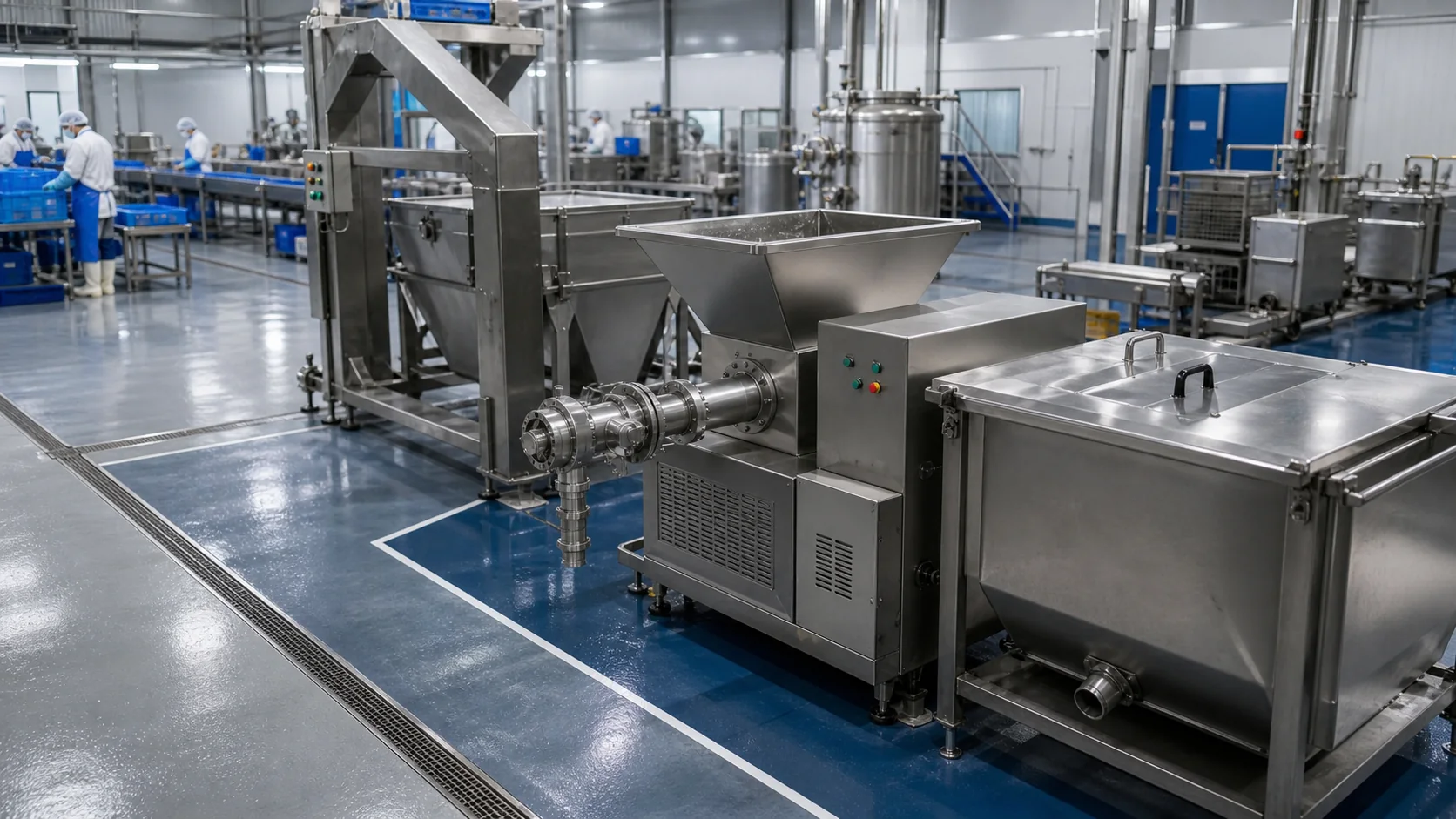
An industrial sausage smokehouse is a controlled chamber, not simply a box that adds smoke. Depending on the product and installed options, a batch program may manage surface drying, smoke exposure, heating and sometimes showering. Fans move conditioned air around the load, while controls coordinate temperature, humidity, dampers and smoke delivery. The processor still has to define and validate the actual process for each sausage. This guide explains what the equipment does, what can vary, and which observations are worth recording.
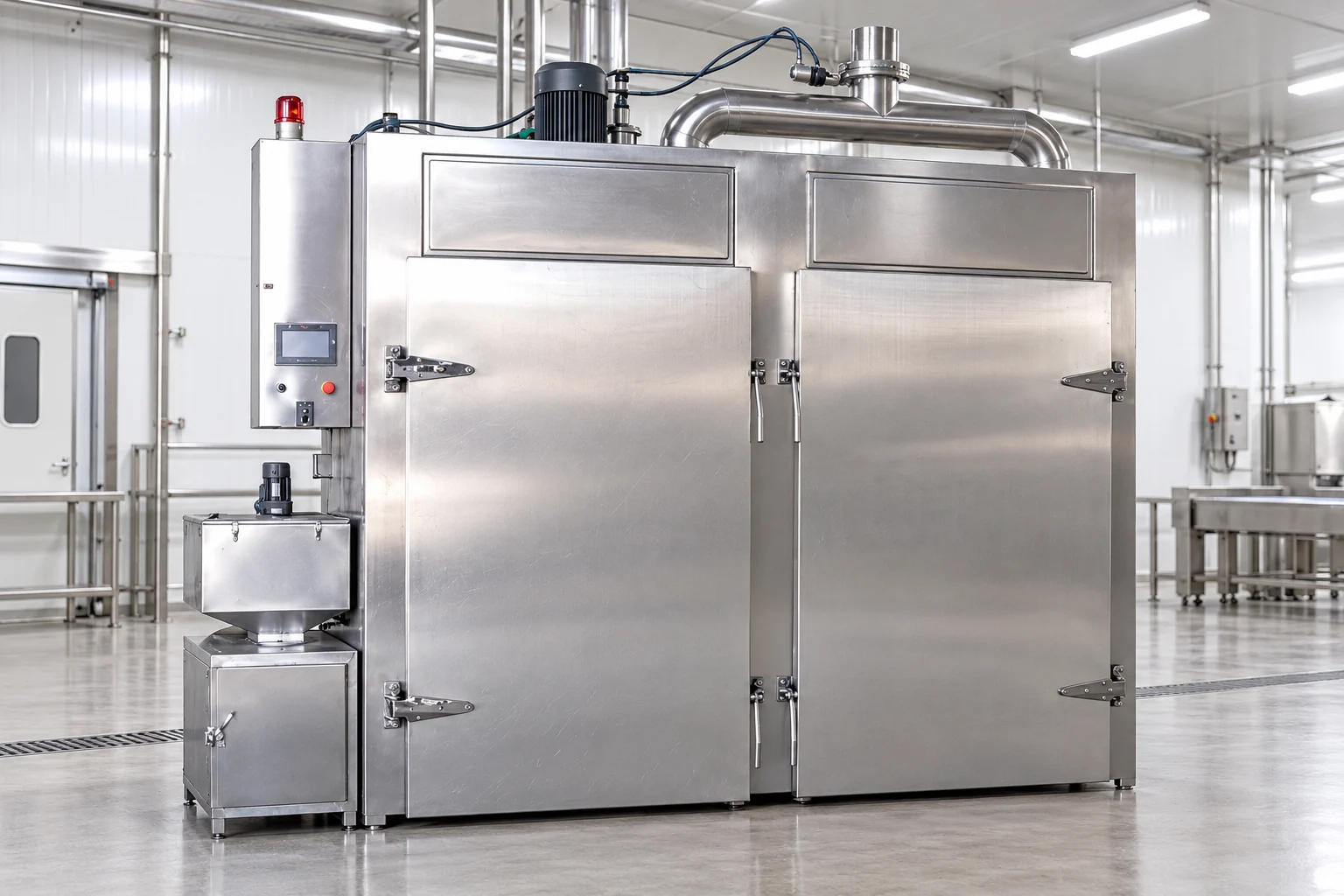
What job does the smokehouse perform?
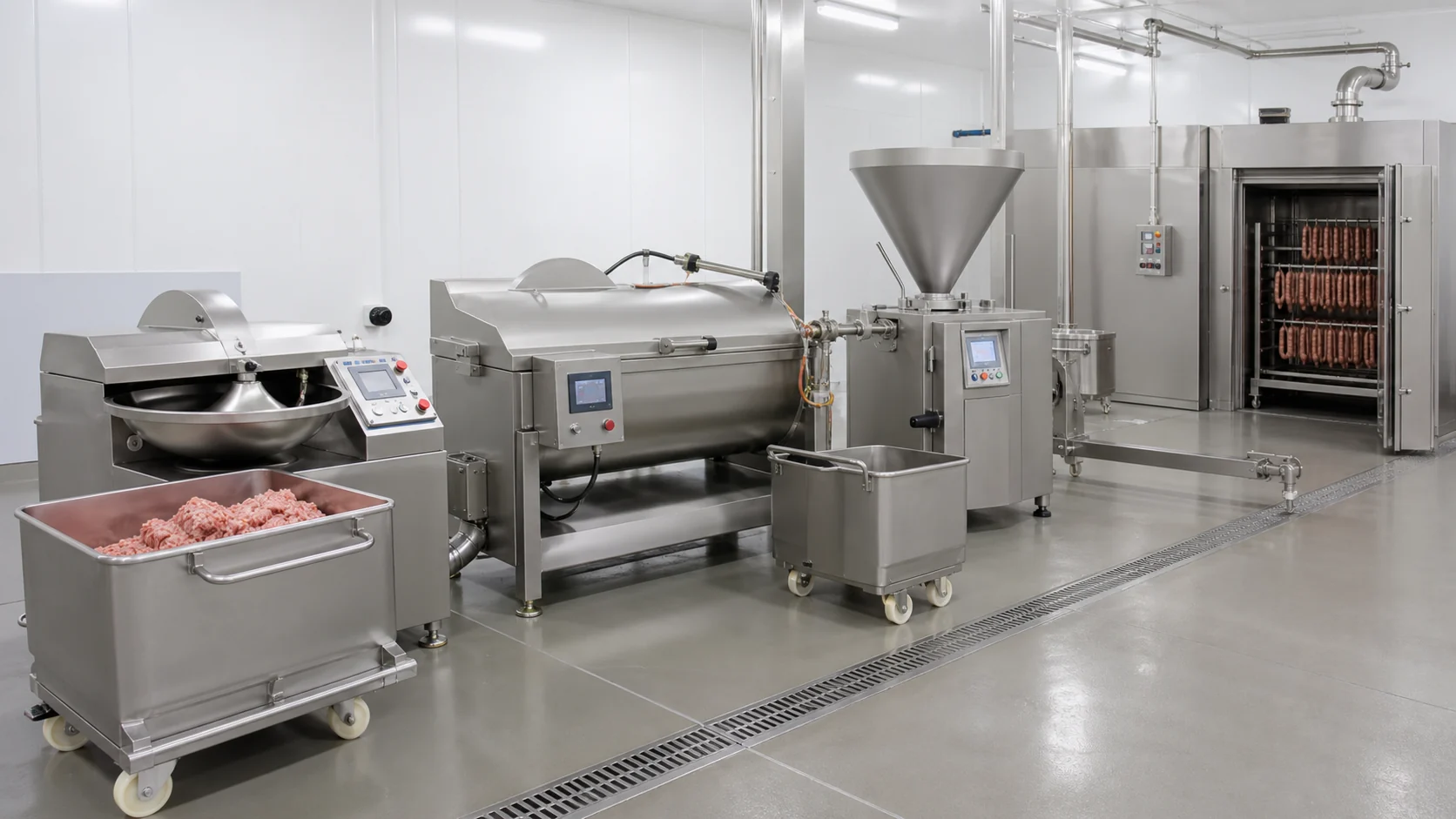
The chamber treats a prepared product after mixing, filling and linking or clipping. It changes the product environment in stages; it does not correct an unsuitable formulation, damaged casing, poor fill or weak upstream hygiene. The useful way to understand the machine is to follow what enters, what the chamber controls, and what leaves. The sausage production line explains the larger equipment sequence; this page concentrates on the thermal chamber itself.
Product entering the chamber
Incoming sausage has a defined formulation, casing, diameter, fill level and initial temperature. Those attributes influence how air, moisture, heat and smoke act during the cycle. Links are typically arranged on rods or trolleys for the proposed chamber layout. The processor should identify whether products are meant to be smoked and cooked, only smoked, or processed through another validated route. Do not use a program for one class of sausage as an automatic recipe for another.
Conditioned air, not direct flame
In a typical industrial unit, circulation fans move air through the chamber and around the load. Heating, humidification, fresh-air intake and exhaust adjust the condition of that air. Smoke may be introduced from a separate generator during the appropriate step. The exact flow path and hardware are model-specific. A supplier should provide a schematic for the unit being quoted rather than relying on a general drawing from another model.
Why loading pattern matters before the program starts
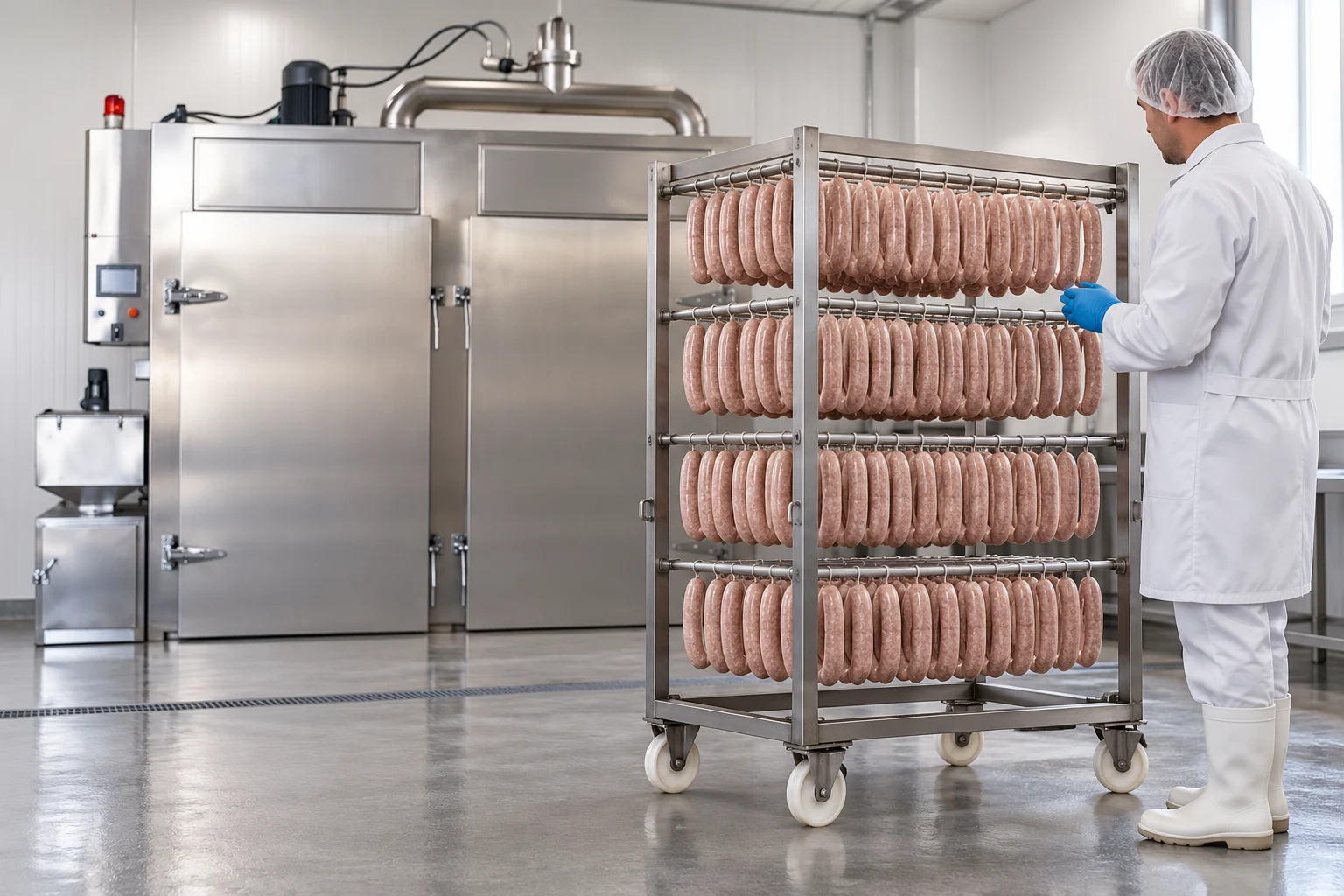
A control screen cannot compensate for product packed so tightly that air cannot circulate. Trolley size, rod spacing, link diameter and the position of the load relative to the air path all affect exposure. A nominal chamber capacity is therefore not the same as a guaranteed quantity of acceptable sausage per batch. Discuss usable loading with the supplier using your actual casing and product format.
Check spacing and presentation
Look for contact points where adjacent sausages touch, fold over rods or obstruct each other. Such areas may receive different drying or smoke exposure from the rest of the load. Document a practical hanging pattern that operators can repeat. Include the rods, trolley and loading method in a trial; a photograph of a bare chamber says little about product-level uniformity.
Know the batch boundary
Define the batch from trolley loading through unloading and transfer to the next controlled step. If a process uses more than one chamber or trolley, identify how batches remain traceable. Record product identity, lot, start condition and program version. That makes it possible to compare a finished batch with the conditions under which it was made, rather than with the machine’s nominal rating alone.
What happens during the drying stage?
Drying changes moisture at the sausage surface under controlled air and exhaust conditions. For many smoked products, surface condition affects subsequent color and smoke deposition. How much drying is needed depends on the casing, formulation, product diameter and intended finish. The aim is not to make every sausage as dry as possible. Excessively aggressive surface drying can create a result that looks acceptable from outside while processing unevenly.
Airflow and exhaust work together
Circulation moves conditioned air around the load; exhaust removes humid air when the process calls for it. Their settings influence the drying environment but do not alone prove that every link has the desired surface condition. Operators should observe both chamber readings and representative product positions, especially when a trolley is densely loaded. Ask the equipment supplier which dampers and humidity controls are present on the quoted model.
Surface appearance is an observation, not a safety result
Color, tackiness and casing feel can help a processor judge whether a drying step is behaving as expected. They cannot establish that the subsequent cooking step is safe. Keep sensory observations separate from the measurements and validated criteria used for food-safety decisions. The [FAO sausage-processing reference](https://www.fao.org/4/x6556e/X6556E05.htm) notes that casing and product properties affect drying and processing time; it does not supply a universal factory program.
How does smoke reach the product?
In a system equipped for smoking, smoke is generated by the specified smoke source and introduced into the moving chamber air. Its distribution depends on airflow, the condition of the product surface, the location of the smoke inlet and the exhaust program. The smoke generator, fuel or smoke medium, cleaning method and emission-handling requirements should be identified for the actual installation. A chamber advertised as a smoking oven does not tell you which generator is included.
Smoke exposure and cooking are different functions
Smoke can contribute flavor and surface color, while heat treatment is evaluated against a separate process objective. A smoked appearance does not demonstrate that the core of a sausage has reached a safe endpoint. In a cooked-smoked product, the factory must monitor the validated cooking process independently of visual smoke uptake. Some products use different sequences or no smoke at all; the program follows the product specification.
Check the generator and exhaust scope
Confirm whether the quotation includes the smoke generator, connections, fuel-handling components, ducting, condensate management and any required emission treatment. These are installation questions as well as equipment questions. Maintenance access matters because residue can accumulate in the smoke path. Use the manufacturer’s approved cleaning procedure and local environmental requirements; do not assume a generic cleaning chemical or exhaust arrangement suits every plant.
How does the chamber heat the sausage?
Heating equipment raises the condition of the circulating air, and energy then transfers into the product. Depending on configuration, a chamber may use electric heat, steam or another designed source. Its air-temperature reading describes the chamber environment; it is not automatically the temperature at the center of every sausage. Product size, load pattern, casing and initial temperature all affect how the center responds.
Distinguish chamber readings from product readings
A temperature display may show air, humidity-related readings or a product probe. Buyers should ask what each sensor measures, where it sits, and how it is calibrated. A representative product probe can provide important information, but one probe location may not represent the slowest-heating part of a diverse load. The plant’s process authority or food-safety team must decide how to identify and monitor the relevant worst-case position.
Do not copy a temperature schedule from a brochure
Time and temperature targets belong to a validated process for the actual product and market. This article deliberately gives no universal cooking schedule. Regulatory category, formulation, casing, diameter, equipment and required outcome may differ. [USDA FSIS guidance on HACCP validation](https://www.fsis.usda.gov/inspection/compliance-guidance/haccp/haccp-validation) distinguishes scientific support from demonstrating that a process works in the establishment. A machine supplier can provide equipment capability; the processor remains responsible for an appropriate, documented food-safety process.
Is there always a shower or cooling step?
No. Some installations include an integrated shower or a linked cooling stage; others transfer products to separate equipment. The choice depends on the product and complete process design. Confirm which features are actually fitted to the quoted commercial smoking oven. A photo or brochure that shows a shower on another model is not confirmation that it is included with yours.
Define the exit path
Plan what happens after the chamber program ends: unloading, cooling, holding and packaging. Treat that movement as part of the production line, not a vague step after the machine. Record who handles the trolley and how product identity is preserved. If the factory has a clean-side and raw-side separation, the chamber location and door arrangement should support the approved flow.
What should operators record during a batch?
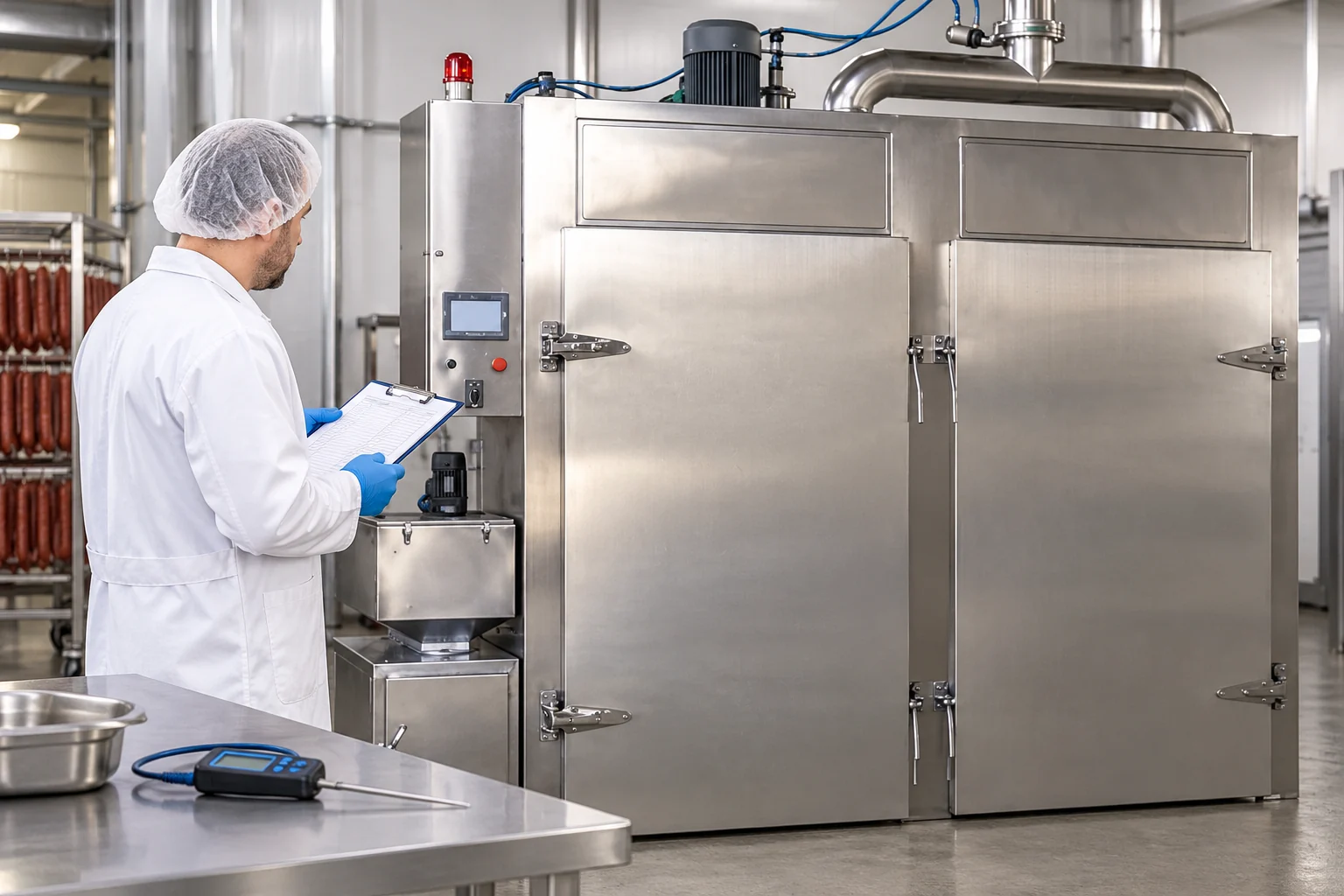
A useful record connects the product, program and observations. It includes the recipe or program version, batch identity, load pattern, relevant chamber measurements, product readings where required, alarms, deviations and the decision made at the end. The exact record set follows the plant’s validated control plan. A data logger or PLC display is useful only if its readings are understood, retained and reviewed.
Review the whole cycle, not a final number
A final displayed temperature alone may hide a long delay, an interrupted stage or a sensor fault. Review the process trace and compare it with the approved program. When evaluating a new machine, ask how operators can export or retrieve data and how alarms are documented. A live trial with a representative load is more informative than a screen showing a successful empty-chamber run.
Use a trial to map uniformity
For an acceptance trial, agree which trolley locations and product positions will be checked. Compare appearance and the required measured values across those positions. Record the initial product state, load density, program and any operator intervention so the result is reproducible. An attractive finished photograph cannot show whether the upper and lower rows followed equivalent conditions.
How should a buyer connect this process to equipment selection?
The working principle helps frame an RFQ. State the sausage types, casings, product dimensions, batch pattern, load arrangement, required process functions, heat source, smoke source and downstream cooling route. Ask for a configuration drawing that identifies included and optional components. The upstream vacuum sausage stuffer and the downstream thermal process should be specified against the same finished-product brief.
Check utilities and installation boundaries
Request the proposed footprint, trolley route, electricity or steam requirement, water and drainage needs, exhaust connection and service access for the exact quoted model. Do not reuse utility numbers from another supplier’s brochure. Confirm what the seller supplies, what the buyer must install, and what will be demonstrated at commissioning. Those boundaries are often more useful than a broad promise of automation.
Ask for a product-specific demonstration
Where possible, run the intended casing and sausage format through the proposed configuration. Agree on the load, stages to demonstrate, records to collect and acceptance criteria before the trial. Separate equipment function checks from food-safety validation. The chamber can show that it controls its designed variables; only a properly supported and in-plant-verified process can establish the intended food-safety outcome.
The practical answer
An industrial sausage smokehouse works by controlling the environment around a loaded product through selected stages such as drying, smoking and heating. Its fans, heat source, humidity or exhaust controls, smoke system and sensors make those stages possible. Product design, loading, recipe settings and validated monitoring determine whether a specific batch meets its goal. To discuss a suitable chamber, send the product and factory requirements with your inquiry, then ask the supplier to show the proposed configuration and a representative trial plan.
Frequently Asked Questions
What does an industrial sausage smokehouse actually control?
It controls the chamber environment through fitted systems for air circulation, heating, moisture management, exhaust and, where included, smoke delivery. The exact functions depend on the quoted machine and the programmed product process.
Why is sausage dried before smoking?
For many smoked sausages, controlled surface drying prepares the casing for the intended smoke and color result. The required stage depends on the casing, formulation, product size and validated process; more drying is not automatically better.
Does a smoked color mean the sausage is fully cooked?
No. Surface color and smoke flavor do not demonstrate the product’s internal cooking outcome. A cooked-smoked sausage needs the measurements and validation specified in the plant’s food-safety process.
Is one smokehouse temperature suitable for every sausage?
No. Time, air conditions and product targets vary by formulation, casing, diameter, equipment and market requirements. Use a product-specific validated program rather than a temperature copied from a brochure.
Is a shower or cooling step included in every smokehouse?
No. Some chambers include integrated showering or linked cooling, while others use separate equipment. Confirm the exact supplied options and how product is moved after the chamber cycle.
What should a processor request for a smokehouse trial?
Request a representative product load, agreed hanging pattern, proposed program, chamber and product readings where required, alarm records and checks at different trolley positions. Separate equipment acceptance from the plant’s food-safety validation.