A frying production line works reliably only when the machines before and after the fryer can handle the same product flow. A large industrial fryer cannot prevent uneven color if wet product arrives in surges, and it cannot protect crisp texture if hot food piles up before cooling or packing. The practical engineering task is to coordinate feed distribution, frying residence, surface-oil removal and downstream acceptance as one controlled process.
This guide focuses on transfer points in an atmospheric continuous frying line for snack and prepared-food factories. It is not a universal recipe or a claim that every food can use the same equipment. Product trials must establish the acceptable temperature profile, residence time, loading pattern and finishing sequence for the actual product.
Start with the product leaving the line
Define the next process, not just the hourly target
State whether the fried product will be seasoned, chilled, frozen, packed as a shelf-stable snack or transferred to another cooking step. Each destination changes what the discharge system must deliver. A thin chip needs gentle handling and controlled moisture protection; a coated prepared food may need a different thermal process and a different cooling or freezing route.
Write the required finished condition before selecting conveyors. Include acceptable breakage, coating retention, surface oil, temperature at transfer, and the inspection method. Do not assume that a golden exterior proves that a meat product has received its required validated cooking process.
Distinguish raw-input capacity from accepted output
Water loss, oil uptake, coating loss and rejects change the weight moving through the line. A raw-feed rating and a finished-product rating are not interchangeable. Ask every supplier to identify the material basis, product condition and operating duration behind its capacity statement.
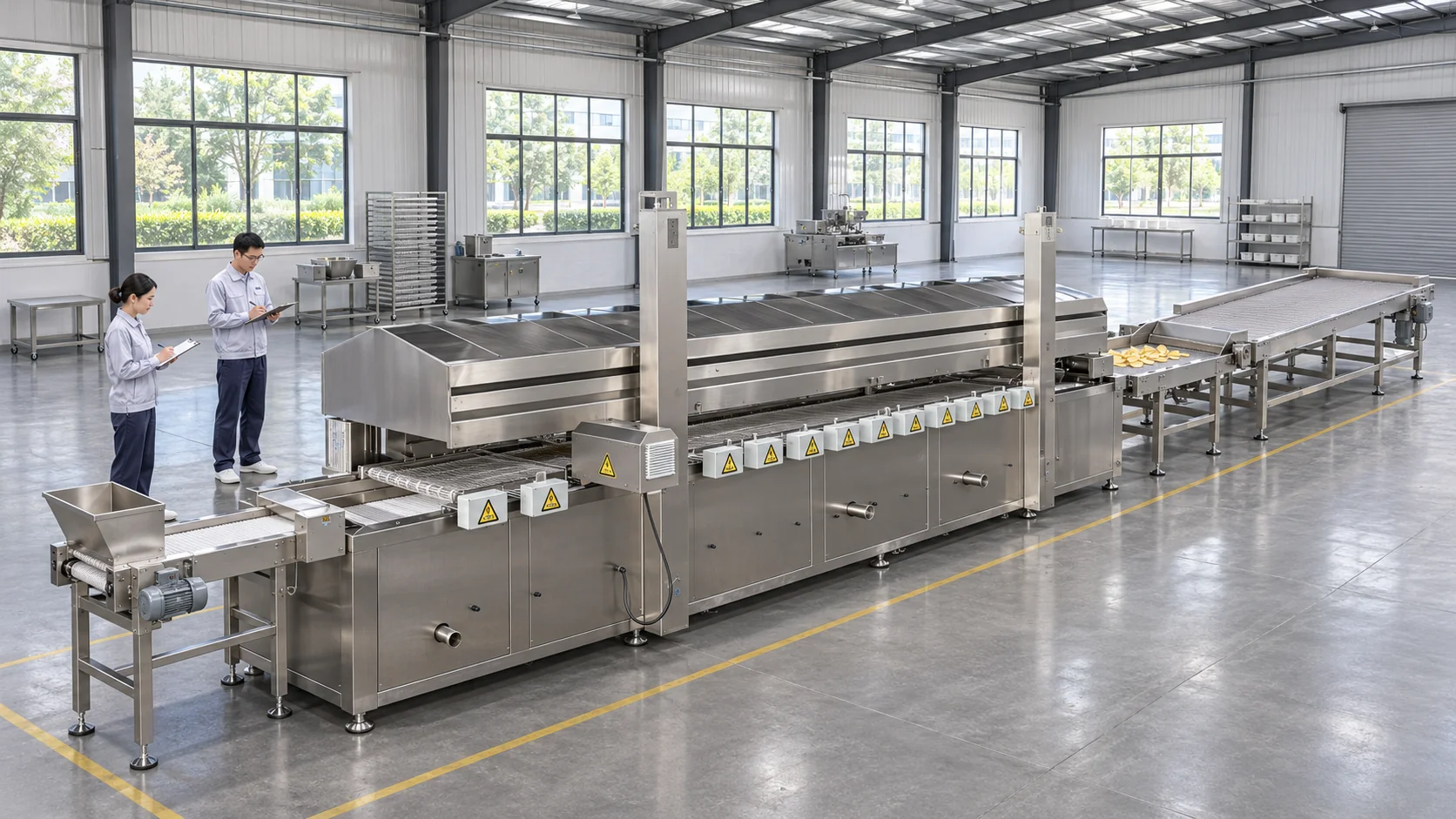
For the core equipment boundary, review the industrial continuous frying machine line. Then define the upstream and downstream machines included in the quotation separately. A photograph of connected equipment does not establish what is supplied.
Control what reaches the fryer entrance
Surface water is an incoming load
Washing, blanching, thawing or battering can leave variable liquid on the product. Uncontrolled carryover changes the thermal load and can create unstable entry behavior. A product-specific draining or dewatering stage may be needed before frying; the correct method must preserve the food or coating rather than merely remove as much liquid as possible.
Specify incoming temperature, preparation state, product dimensions and the expected range of surface moisture. These are trial conditions, not minor notes to add after the fryer has been ordered. Never introduce unapproved wet material into hot oil or use improvised water tests.
Spread across useful belt width
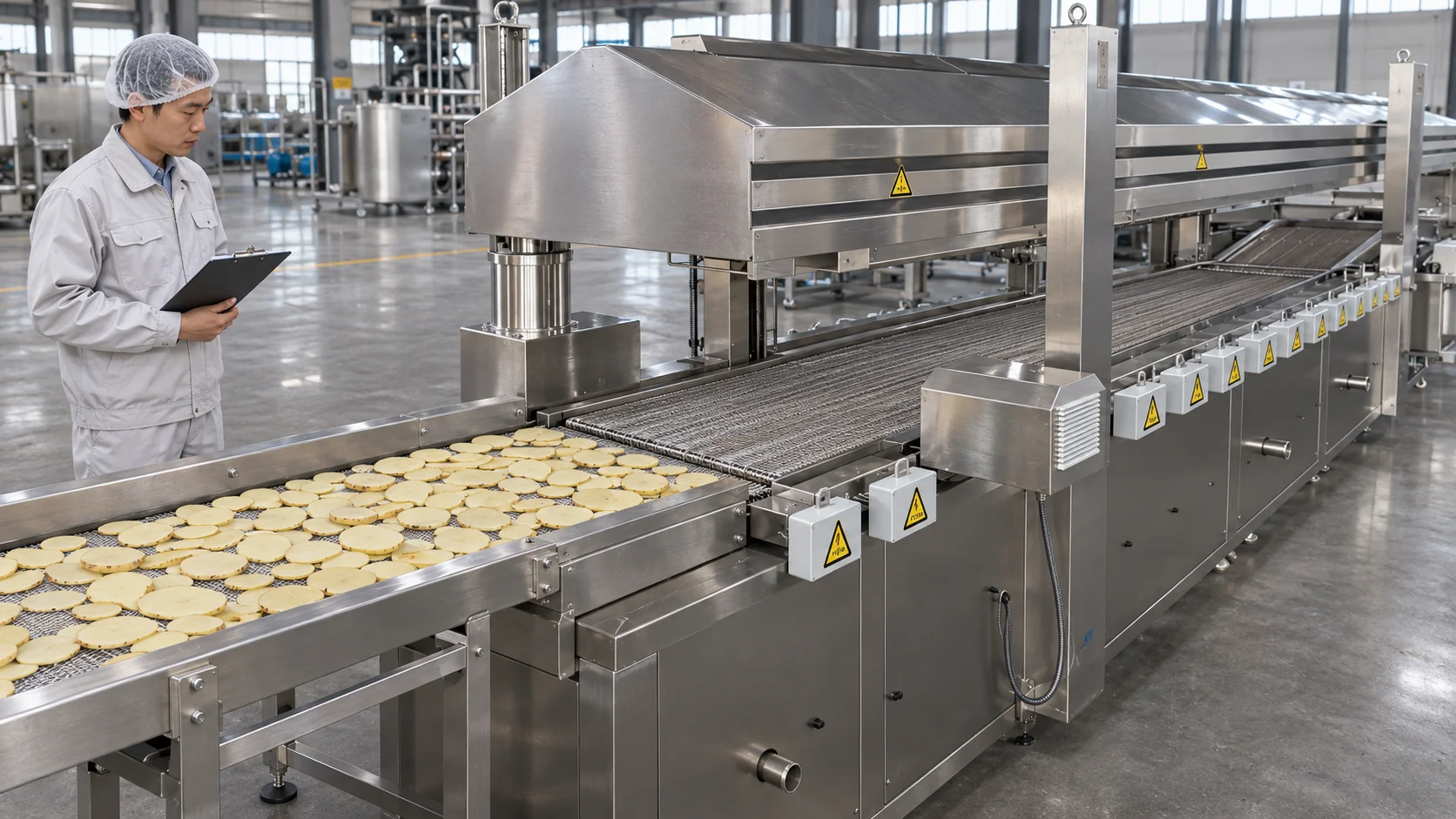
Average feed weight can look correct while the belt center is overloaded and the edges are nearly empty. Inspect the actual product bed across the width. Clumps and overlapping pieces can change oil contact and residence behavior even when the speed display remains unchanged.
A metering feeder, suitable distribution conveyor or other approved spreading arrangement should be selected around the product. Fragile slices, sticky coated pieces and expanding pellets do not behave alike. Ask for representative material during the demonstration instead of accepting a trial with an easier substitute.
Protect coating before oil contact
For coated products, excessive drops, abrupt changes in direction or unsuitable belt transitions may remove coating before frying. The loose material then becomes a product-loss and oil-filtration burden. Check transfer height, belt surface, product orientation and the allowed delay between coating and frying.
The battering and breading machine line is an upstream process option, not an automatic part of every frying project. Include it only when the approved product requires it.
Coordinate loading and frying residence
Conveyor speed is only part of the answer
For a product following a conveyor without significant slip, a starting residence estimate is effective frying travel divided by belt speed. That estimate is not a substitute for a product trial. Floating behavior, submerger arrangement, oil movement, loading and product dimensions can alter the actual journey through the frying zone.
Verify the complete residence distribution using the manufacturer’s safe test method. Record settings together with product loading and output condition. Increasing feed to fill a downstream order should not silently invalidate the accepted process.
Do not solve a feed surge with temperature alone
A heavy surge can lower oil temperature and crowd the belt at the same time. Raising the setpoint may not address either the distribution problem or the time needed for thermal recovery. Stabilize the incoming stream, then evaluate temperature recovery under the agreed production load.
Record the available sensor readings and their locations. One display does not necessarily describe conditions everywhere along a long fryer. Any multi-zone heating or circulation feature must be confirmed for the quoted configuration rather than inferred from a generic product description.
Separate cooking control from discharge coordination
The acceptable frying process remains a product requirement. Downstream convenience should not determine it. If the packer runs slowly, slowing the fryer belt can extend frying time and change the product. The response belongs in an engineered line-control plan, not in an operator’s informal adjustment.
Make the first discharge transfer gentle and predictable
Check the drop and receiving surface
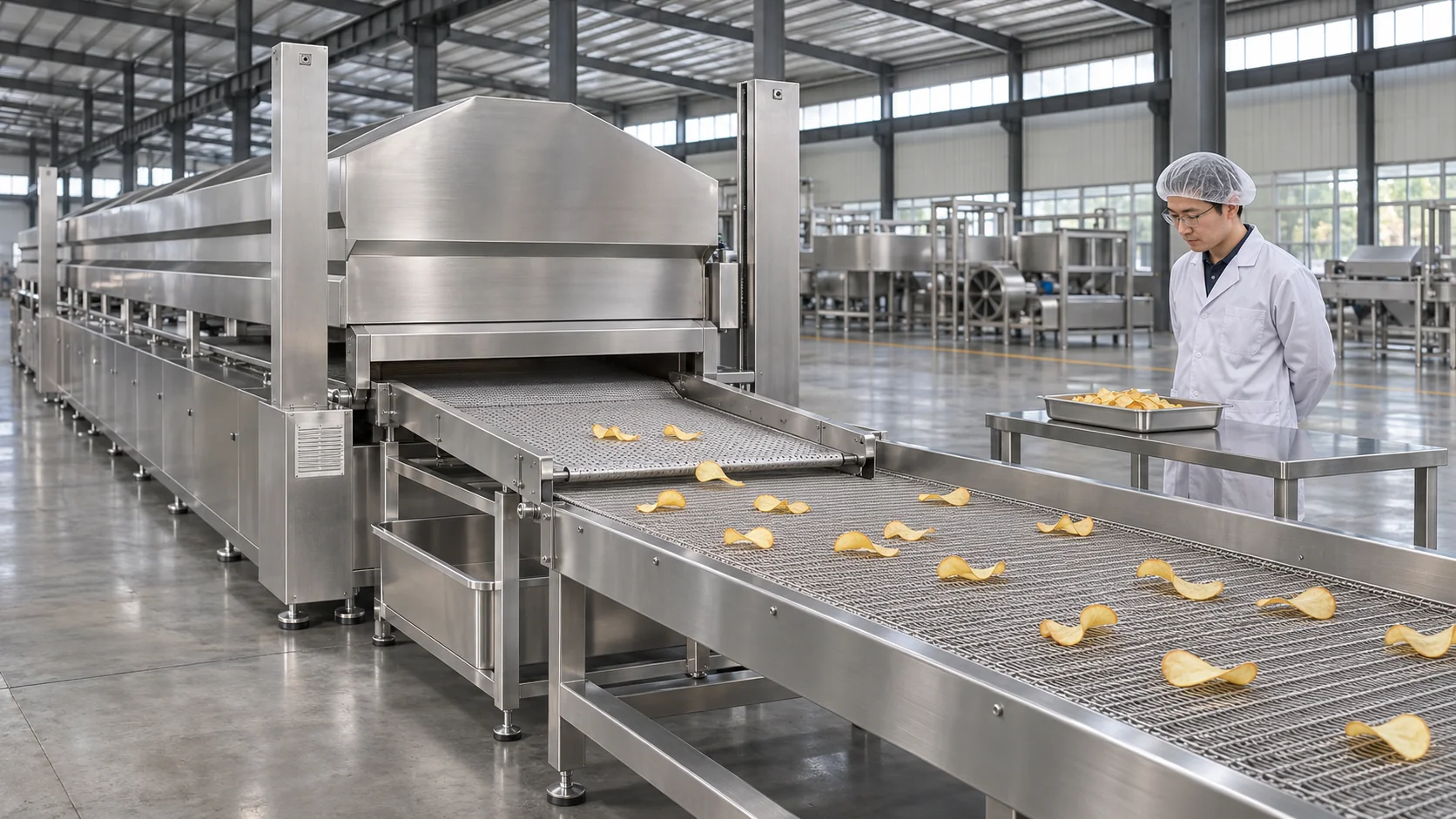
At discharge, food can be fragile, hot and carrying free surface oil. Inspect how it leaves the belt and lands on the next machine. A receiving conveyor positioned too low can increase breakage; a transfer that is too narrow can create a mound even when nominal hourly capacity appears adequate.
Include transfer height, usable width, clearance, belt-end geometry and access in the approved layout. Confirm that collection trays and oil-return arrangements remain accessible without requiring staff to reach into moving machinery.
Match oil removal to product strength
Draining, vibration, air-assisted systems and centrifugal equipment perform different handling jobs. A method suitable for a robust snack may damage a delicate coated item. Evaluate surface-oil removal and mechanical damage together instead of selecting a machine from a generic de-oiling percentage.
Removing free surface oil does not mean removing all absorbed oil. Do not promise a finished fat level without a defined analytical method and representative trial. The selected finishing step should produce repeatable results without crushing, stripping or cooling the product unpredictably.
Keep product oil and frying-oil filtration distinct
A de-oiling conveyor handles the food after frying. An oil filter removes particles from the circulating frying medium. These are not interchangeable functions. Coating fines or food fragments should not remain indefinitely in the hot system simply because the finished product passes through a de-oiler.
Ask suppliers to show the oil route, residue-removal route, safe access and cleaning boundary. Filter capability, circulation flow and operating temperature are configuration-specific. Filtration does not restore chemically degraded oil to a new condition or replace the plant’s oil-quality program.
Treat cooling and packing as a capacity constraint
A longer conveyor is not automatically a cooler
Cooling depends on the incoming product condition, bed depth, air conditions, residence and the required endpoint. A long belt carrying a deep pile may not achieve the same result as a properly distributed product bed. Specify the acceptable condition at the next process, then test it at sustained output.
Warm snack products can create moisture and texture problems when packed before their approved endpoint. For meat and other perishable foods, chilling and freezing requirements need a validated product-specific food-safety plan. Ambient conveying must not be presented as a universal safe cooling method.
Position seasoning according to the recipe
Some products need seasoning while their surface condition supports adhesion; others follow a different order. Establish the sequence during trials. Specify the seasoning load, application uniformity, tumble intensity, breakage limit and cleaning requirements instead of assuming every line needs the same drum.
State what happens when packing pauses
A packer interruption is a normal event that the line should anticipate. Define the response before production: stop or reduce incoming feed, manage material already inside the fryer, and protect the identity of affected product. The controls engineer and process team must agree on the safe sequence.
A buffer is useful only when its product condition, holding time, capacity and release rule have been approved. It cannot justify unlimited hot-product accumulation. Do not override guards or keep feeding into a blocked transfer to avoid an apparent loss of production time.
Test transfers under realistic conditions
Use a stable-run acceptance test
Run the representative product long enough to evaluate steady loading, thermal recovery, residue handling and the downstream endpoint. Record accepted output, rejects, breakage, coating loss, settings, product condition and interventions. A short clean-machine video is useful for identification, but it does not prove an entire shift’s performance.
Include a controlled interruption demonstration
Ask the supplier to demonstrate the approved response to a downstream interruption under its documented safe test procedure. Confirm which signals pass between machines, how infeed is prevented from restarting unexpectedly, and how affected material is identified. Do not improvise faults in hot-oil equipment or disable protective systems for a demonstration.
Assign product disposition after restart
Material that remained in a changed process condition needs an assessment rather than automatic mixing with accepted production. Define the affected time window, segregation method and release authority. Record the reason for the stop and confirm that the approved product condition has returned before routine release resumes.
Put the interface requirements into the quotation
A useful quotation describes the boundary between machines as clearly as the machines themselves. Request an agreed layout and an interface list covering:
- Product dimensions, preparation, incoming temperature and coating condition.
- Raw-feed and accepted-output bases, steady run length and expected changeovers.
- Transfer heights, widths, drops, belt surfaces and product-support needs.
- Heating source, available utilities, extraction and professionally designed fire protection.
- Oil circulation, filtration, storage, draining and safe cleaning scope.
- Downstream cooling, seasoning, freezing or packing endpoint and acceptance method.
- Control signals, stop categories, restart permissions and affected-product disposition.
- Operator access, sanitation clearance and responsibility for integration.
A batch-based project may still be the appropriate choice for short or varied campaigns; our tilting basket fryer is a separate production method, not a substitute for validating continuous transfers. Vacuum frying is also a distinct process and should not be assumed from the term automatic frying line.
The acceptance rule for a connected frying line
Accept the line when representative food moves consistently through every agreed transfer and reaches the specified next-process condition without unacceptable buildup, damage or uncontrolled holding. Confirm that normal interruptions have an approved response. Tank size, heater rating and belt speed are useful specifications, but the connected process is what produces saleable food.
For a project review, send product photos, preparation details, intended finishing route, output basis and a factory layout through the equipment inquiry page. This information allows the fryer and its transfer equipment to be evaluated as one practical production system.
Frequently Asked Questions
What equipment belongs in a frying production line?
The scope depends on the product and finishing route. It can include metered feeding, a continuous fryer, oil filtration, draining or de-oiling, cooling, seasoning and a packing interface. Confirm each supplied module in the quotation.
Why does even infeed matter in a continuous fryer?
Uneven loading changes crowding and the thermal load across the belt. A controlled feed helps the accepted frying process remain repeatable, but the correct distribution must be established for the actual food.
Can belt speed alone determine frying time?
No. Effective travel divided by speed gives a starting estimate only when the product follows the conveyor. Floating behavior, oil movement, loading and the belt arrangement require a safe product-specific residence test.
Is a de-oiling conveyor the same as an oil filter?
No. A de-oiling stage removes free surface oil from food after frying. A frying-oil filter removes particles from the circulating oil. Neither function replaces the other or guarantees a finished fat level.
What should happen when the packing machine stops?
Use the engineered line-control procedure to manage infeed and material already in process. Define any approved buffer, affected-product segregation and restart permissions before production; do not improvise changes to frying residence.
How should a connected frying line be accepted?
Test representative food at sustained output and verify transfer behavior, product condition, damage, oil handling and downstream readiness. Include the approved interruption response and a clear release rule for affected material.